Introduction
Across the global agribusiness and ingredients landscape, corn starch has evolved from a basic commodity into a strategic input for food, pharmaceuticals, paper, packaging, textiles, and even bioplastics. As the world’s largest corn producer and one of the leading starch processors, the United States sits at the center of this transformation. Yet, the real story of U.S. corn starch demand is not told only by domestic production figures; it is revealed by global trade flows, import–export patterns, and shifting value chains.
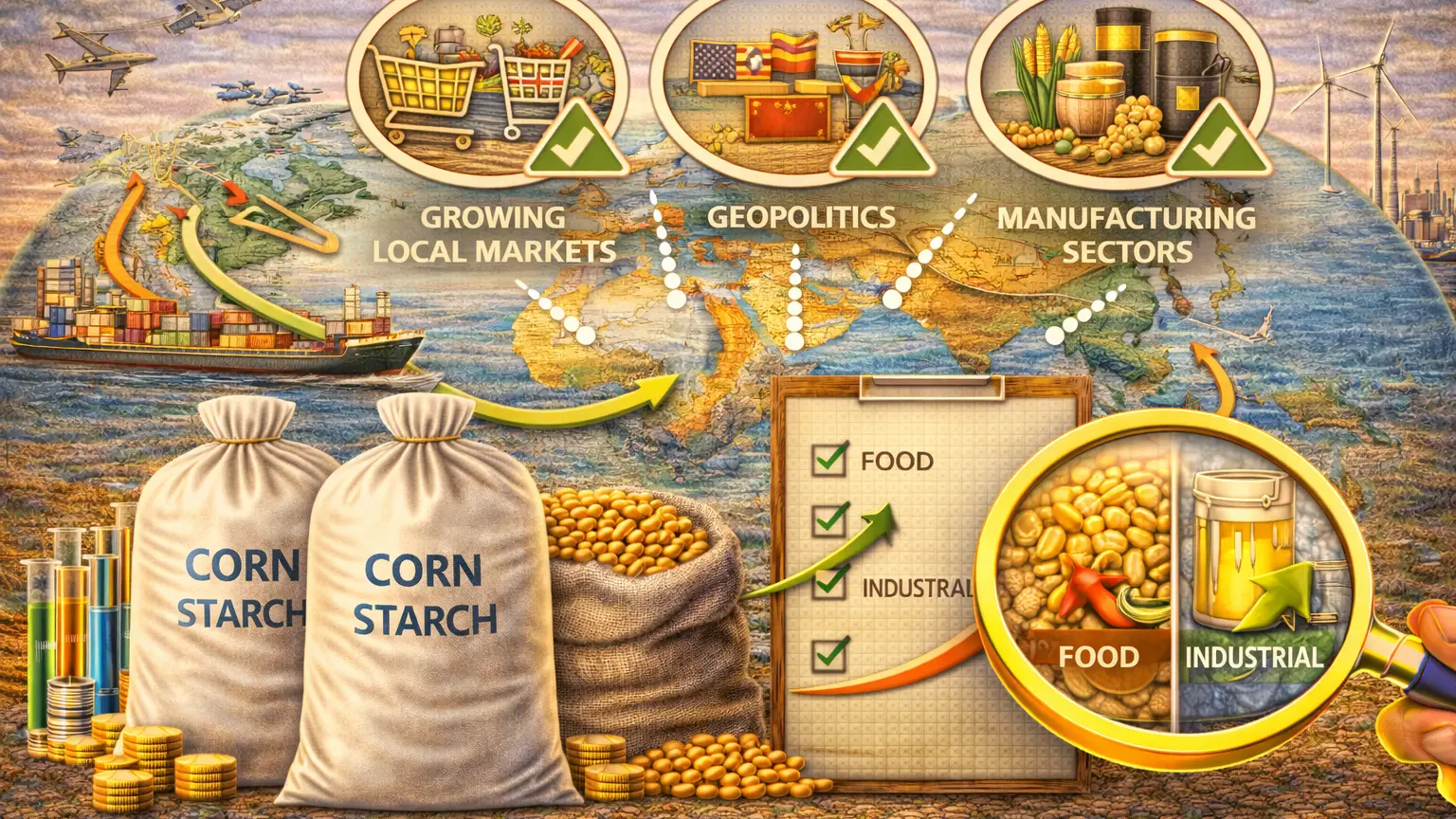
Over the last decade, international trade data from organizations such as the FAO, UN Comtrade, and the USDA shows a steady expansion of starch and starch-derivative flows, particularly from major Asian and European processing hubs into North America. While the U.S. is a net exporter of many corn-based products, it also imports specialized starches and derivatives to meet the growing needs of food formulators, industrial users, and brand owners. These flows highlight how demand is becoming more sophisticated, moving beyond bulk native starch to higher-value modified and functional starches.
This article examines what global trade flows reveal about corn starch demand in America, and how product offerings such as native corn starch and modified corn starch from chemtradeasia.com align with these trends. By looking at trade routes, demand drivers, and application segments, American buyers can better understand where the market is heading and how to secure reliable, cost-effective supply in a competitive global environment.
Global Corn Starch Trade Flows and U.S. Position
Global corn starch trade is shaped by a handful of major producing regions: North America (primarily the U.S.), Europe (notably France, Germany, and the Netherlands), and Asia (China, Thailand, and increasingly Vietnam and Indonesia). According to international trade statistics, world exports of starches and starch products have grown steadily over the past decade, with Asia’s share rising as new processing capacity has come online and logistics networks have improved. This has led to more competitive pricing and a wider range of specialty starches available on the global market.
The United States plays a dual role in this system. On one hand, it is a significant exporter of corn-based sweeteners, ethanol by-products, and bulk starches, especially to Latin America and parts of Asia. On the other hand, the U.S. imports selected volumes of specialty and modified starches from Asia and Europe. These imports often include products tailored for specific technical performance, such as high-viscosity starches for paper and corrugating, pregelatinized starches for instant foods, or acetylated and cross-linked starches for demanding industrial processes. The fact that such products are imported into an already corn-rich country signals that U.S. demand is not only large, but also increasingly differentiated.
Trade flows also reveal a clear pattern of regional specialization. Asian processors, supported by cost-competitive labor and proximity to fast-growing consumer markets, have become strong suppliers of both native corn starch and value-added modified corn starch. Platforms like chemtradeasia.com connect these producers with American buyers, consolidating supply from multiple certified plants and offering flexible volumes. For U.S. importers, this diversification of supply sources is strategically important: it mitigates risk from domestic crop variability, price volatility, or capacity constraints, while enabling access to tailored specifications that may not be economical to produce locally at smaller scales.
Key Demand Drivers for Corn Starch in America
Corn starch demand in the U.S. is anchored by the food and beverage sector, which accounts for a significant share of total consumption. In bakery, snacks, dairy, sauces, and ready meals, corn starch is used as a thickener, stabilizer, and texturizer. As American consumers shift toward convenience foods, clean labels, and plant-based alternatives, formulators rely on starch to deliver desired mouthfeel and stability while managing cost. Trade data shows robust imports of specialized food-grade starches, reflecting the need for consistent quality and functionality tailored to specific products such as gluten-free baked goods or low-fat dairy analogs.
Beyond food, industrial applications are a key driver of U.S. corn starch demand. The paper and packaging industry uses starch as a binder and surface sizing agent to improve strength and printability. Corrugated box production, which surged alongside the growth of e-commerce, depends heavily on reliable starch adhesives. In textiles, starch is used for warp sizing and finishing, while in construction and gypsum board manufacturing it serves as a binder. These sectors often require modified starches with precise viscosity and performance characteristics, which explains why imports of industrial-grade modified starches have grown in parallel with domestic production.
Another important driver is the rise of bio-based and sustainable materials. As American companies seek to reduce reliance on petroleum-based chemicals, corn starch-based bioplastics, biodegradable packaging, and eco-friendly adhesives are gaining traction. Trade flows show increased movement of specialty starches and derivatives suitable for such applications, including thermoplastic starch (TPS) blends and starch used as a filler or performance additive in biopolymer systems. Suppliers accessible via chemtradeasia.com are well positioned to support this transition, offering technical-grade starches that can be integrated into R&D and commercial-scale projects focused on sustainability.
Product Spotlight: Native and Modified Corn Starch from chemtradeasia.com
Within this evolving trade landscape, sourcing the right product is as important as understanding macro trends. chemtradeasia.com acts as a global trading platform connecting American buyers with reputable producers of native corn starch and modified corn starch across Asia and other regions. Native corn starch offered through the platform typically features moisture content in the range of 12–14%, pH around neutral, and high whiteness, making it suitable for both food and industrial applications. Particle size distribution and microbiological parameters are controlled according to international standards, which is essential for U.S. buyers who must comply with FDA and other regulatory requirements.
Modified corn starch products available through chemtradeasia.com include a variety of chemical and physical modifications such as oxidized starch, cationic starch, acetylated starch, cross-linked starch, and pregelatinized starch. These modifications are designed to enhance specific functionalities—improved viscosity stability under shear and heat, better film-forming properties, enhanced adhesion, or cold-water solubility. For example, pregelatinized starch is ideal for instant soups and bakery mixes where rapid hydration is required, while cationic starch is widely used in paper manufacturing to improve retention and strength. By offering a portfolio of such products, the platform allows U.S. buyers to match precise technical needs with the appropriate starch grade.
From a commercial standpoint, chemtradeasia.com emphasizes consistent quality, competitive pricing, and logistical flexibility. Products are typically available in standard packaging formats such as 25 kg bags, jumbo bags, or customized packaging upon request. The platform supports shipment in full container loads or partial loads depending on buyer requirements, which is particularly valuable for small and medium-sized manufacturers in America who may not have the volume to contract directly with large overseas mills. Additionally, documentation support—such as certificates of analysis, origin, and compliance—helps streamline customs clearance and regulatory checks, reducing the friction often associated with international sourcing.
Applications and Benefits of Corn Starch Across U.S. Industries
In the U.S. food and beverage sector, corn starch is prized for its functional versatility and cost-effectiveness. Native corn starch from suppliers represented on chemtradeasia.com is commonly used in soups, sauces, gravies, bakery fillings, and confectionery to provide body, thickness, and a smooth texture. Modified food starches can withstand higher processing temperatures, freeze–thaw cycles, and mechanical shear, which is crucial in frozen meals, retort products, and high-speed filling lines. The benefit to American food manufacturers is the ability to fine-tune texture and stability while maintaining clean labels and competitive ingredient costs.
Industrial users leverage corn starch for its adhesive and binding properties. In paper and packaging, oxidized and cationic starches are used in wet-end and surface applications to increase strength, improve print quality, and optimize runnability on high-speed machines. Corrugators depend on reliable, fast-gelling starch adhesives to maintain board integrity and productivity. Construction materials such as gypsum board and mineral wool panels use starch as a binder to enhance cohesion and mechanical performance. These applications underscore the value of having a stable supply of industrial-grade starches with consistent viscosity profiles and minimal impurities—features that reputable producers on chemtradeasia.com are able to deliver.
Emerging applications are also shaping the market. In pharmaceuticals and nutraceuticals, corn starch is used as a disintegrant and filler in tablets and capsules, while in personal care it can serve as a natural absorbent and texturizer. Bioplastics and biodegradable packaging solutions, often based on blends of starch with PLA or other bio-resins, are expanding as brands respond to regulatory and consumer pressure for sustainable materials. Here, the benefits of corn starch—renewability, biodegradability, and compatibility with existing processing infrastructure—align closely with U.S. sustainability goals. By offering a range of technical-grade starches, chemtradeasia.com enables American innovators to prototype and scale such solutions without being constrained by local supply limitations.
Future Outlook and Strategic Sourcing Considerations
Looking ahead, global trade flows suggest that U.S. corn starch demand will continue to grow in both volume and complexity. Factors such as population growth, urbanization, and the ongoing shift toward processed and convenience foods will support steady consumption. At the same time, decarbonization policies, plastic reduction initiatives, and circular economy strategies are likely to boost demand for starch-based materials and bio-chemicals. This means American buyers will increasingly seek not just bulk starch, but specialized, high-performance products tailored to specific applications and sustainability targets.
However, the corn starch supply chain is not immune to risk. Weather-related crop variability, geopolitical tensions, freight cost volatility, and energy prices can all impact availability and pricing. Trade data in recent years has shown episodes of tight supply and sharp price movements, particularly when major producing regions experience drought or policy shifts. For U.S. manufacturers, this underscores the importance of diversifying supply sources and building resilient procurement strategies that combine domestic and international options.
Platforms like chemtradeasia.com play a strategic role in this context by aggregating supply from multiple regions, offering alternative origins, and providing market intelligence on price and availability trends. American buyers can leverage such platforms to benchmark offers, secure long-term contracts, or source niche grades that are not readily available domestically. By aligning technical specifications, quality expectations, and logistics planning with a trusted trading partner, U.S. companies can turn global trade flows from a source of risk into a competitive advantage in their corn starch sourcing strategy.
Conclusion
Global trade flows offer a powerful lens through which to understand corn starch demand in America. While the U.S. remains a dominant producer of corn and starch derivatives, import patterns reveal a growing appetite for specialized, high-functionality products that support advanced food formulations, industrial processes, and sustainable materials. The interplay between domestic production and international sourcing is reshaping how American buyers think about supply security, cost, and innovation.
As food, industrial, and bio-based applications expand, the need for reliable, high-quality native corn starch and modified corn starch will only intensify. By tapping into global networks of producers through platforms like chemtradeasia.com, U.S. companies gain access to a broad portfolio of starch solutions, competitive pricing, and resilient supply options. In an environment where both demand and risk are rising, informed use of international trade channels becomes a key differentiator.
Ultimately, what global trade flows reveal is that corn starch in America is no longer a simple commodity; it is a strategic ingredient at the crossroads of food security, industrial performance, and sustainability. Companies that understand these dynamics and build smart sourcing partnerships will be best positioned to capture growth and maintain stability in the evolving corn starch market.
Leave a Comment