
Freight’s Twofold Impact on Chemical Pricing
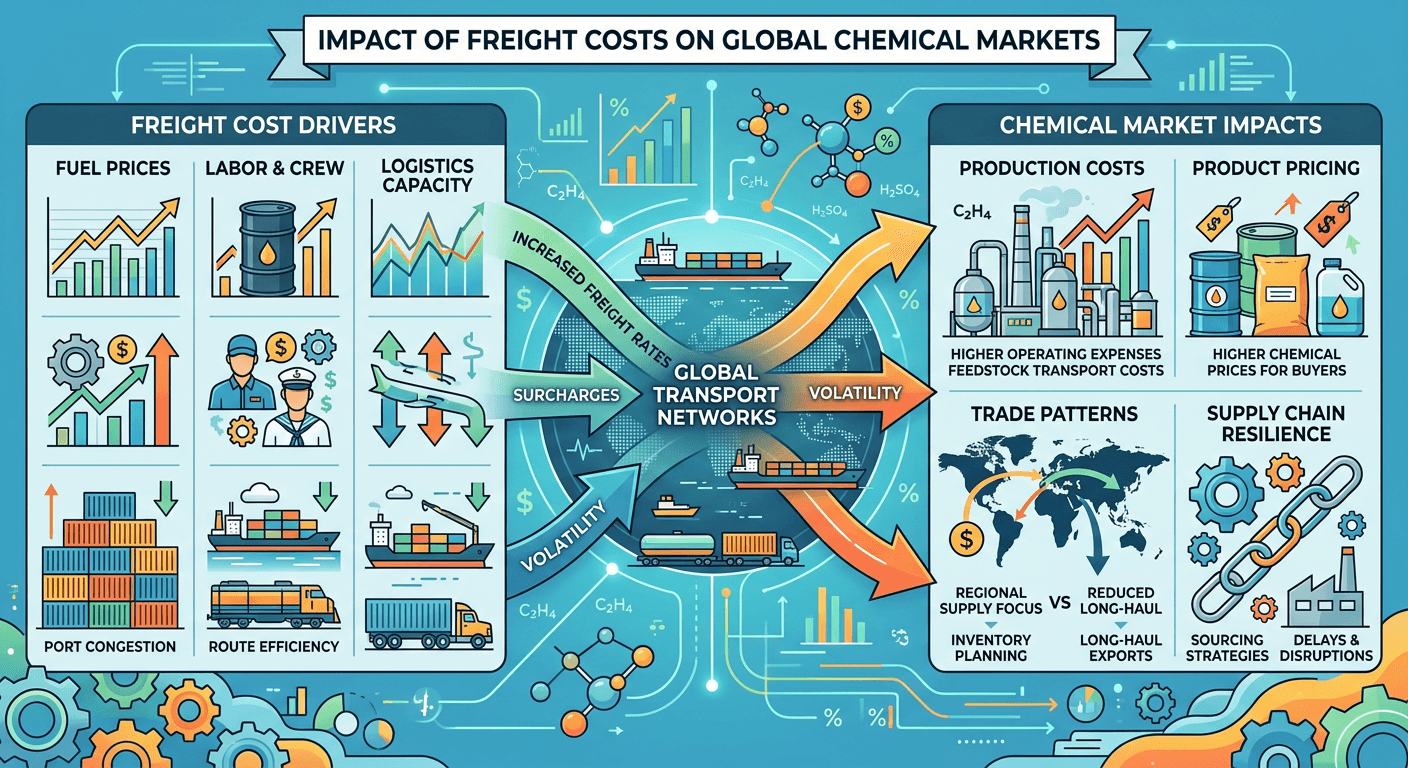
When a chemical supplier quotes a price, the figure most often represents the FOB (free on board) value. Yet the amount a buyer ultimately pays—called the landed cost—includes freight, insurance, and handling. In volatile shipping markets, even a relatively small change in freight can shift the landed cost enough to alter a buyer’s cost‑benefit calculus.
- Landed Cost: Freight is added to the FOB price to calculate what the buyer actually pays at the destination port.
- Supply Availability: High freight rates can render certain routes uneconomic, effectively shrinking the available supply of chemicals on the market.
The 2026 Strait of Hormuz Shock
In early 2026, geopolitical tensions in the Strait of Hormuz intensified, sending the Shanghai Containerized Freight Index (SCFI) through a 93% spike since February. Shipping lines responded by raising the Container Surcharge Index (CSI) across the board. The Drewry Worldwide Container Index (WCI) also surged, hitting USD 3,433 per 40‑foot Equivalent Unit (FEU) in early June—a 23% jump within a single week.
Container Operators Stack Surcharges
Major carriers—CMA CGM, Hapag‑Lloyd, and MSC—have layered multiple surcharge categories to cover the increased risk and cost profile:
- Peak Season Surcharge
- War Risk Surcharge
- Fuel Surcharge
- General Rate Increase
Each surcharge is applied on top of the base freight rate, so the cumulative effect compounds the final cost to the end‑user.
Quantifying the Price Impact
For buyers operating under CIF (cost, insurance, freight) or CFR (cost, freight) terms, the freight component directly translates into commodity price adjustments. A recent analysis shows:
- Every USD 100 per FEU rise in freight adds roughly USD 3–5 per metric ton (MT) to liquid chemical costs.
- For polymer shipments from Asia to Europe, the same USD 100/FEU hike translates to an additional USD 2–3 per MT.
These figures illustrate how freight surcharges can erode margins or trigger price renegotiations across the supply chain.
Strategic Implications for Buyers
1. Lock‑in Forward Contracts: Securing freight rates in advance can hedge against sudden index spikes.
2. Diversify Shipping Routes: Exploring alternative ports or modes (e.g., rail or inland waterways) can mitigate the impact of high sea freight.
3. Negotiate Tiered Pricing: Instead of flat FOB prices, buyers can request tiered pricing that adjusts with freight cost fluctuations.
4. Collaborate with Suppliers: Joint cost‑sharing agreements or shared risk pools can spread the freight burden.
Conclusion
Freight costs are no longer a peripheral consideration; they are a central variable that shapes chemical market dynamics. As shipping indices continue to fluctuate—driven by geopolitical events, fuel volatility, and carrier pricing strategies—chemical buyers must adopt proactive strategies to manage landed costs and maintain supply resilience.